India’s Landmark Ruling On Menstrual Health Sparks Global Call For Menstrual Justice
For millions of girls around the world, menstruation is not just a biological process but a barrier to education, dignity and equal opportunity. A landmark ruling by the Supreme Court of India may now be changing that narrative.
In a historic judgement delivered on 30 January 2026, the Supreme Court of India declared menstrual health a fundamental right, linking it to the right to life and dignity under Article 21 of the Indian Constitution.
The ruling makes India the first country in the world to constitutionally guarantee menstrual health.
The court emphasised that the right to life goes beyond mere existence and includes living with health, dignity and self-respect, while also calling for an end to the shame and stigma surrounding menstruation.
To ensure the judgment leads to real change, the court has scheduled a review hearing three months after the ruling to assess how effectively its directives are being implemented across the country.
Gender justice activist Debanjana Choudhuri described the ruling as a major step in addressing the silence and neglect surrounding menstruation.
According to her, recognising menstrual health under constitutional protections acknowledges a reality shaped by patriarchal attitudes, stigma and social taboos, which have long affected the lives of girls and women.
The court’s decision is particularly significant in a country where menstruation-related challenges contribute to school dropouts.
In India, one in four adolescent girls reportedly misses school due to difficulties managing menstruation, while government data shows that about four million girls have dropped out of primary education in the last four years.
Legal expert Ruchi Bhattar explained that the 127-page judgement mandates state authorities to take practical steps, including providing functional gender-segregated toilets with water and handwashing facilities in schools, ensuring a regular supply of free biodegradable sanitary pads, establishing safe disposal systems, and integrating menstrual education into school curricula to reduce stigma.
The judgment also stresses that infrastructure alone is not enough. It calls for men and boys, including teachers and peers, to play a role in dismantling menstrual stigma, describing menstrual dignity as a shared social responsibility.
Quoting the court, Bhattar noted its message to young girls affected by menstrual stigma: “The fault is not hers.”
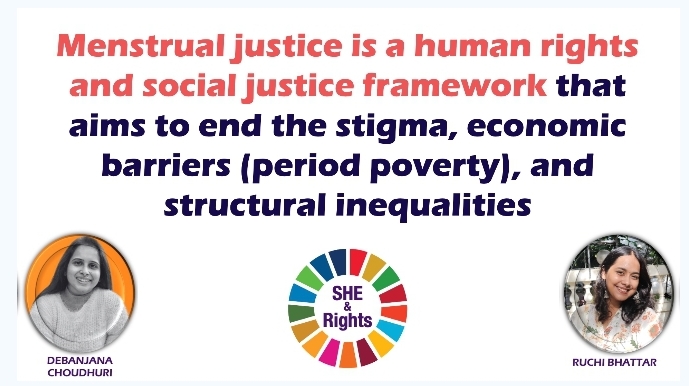
Advocates say the ruling also highlights the broader concept of menstrual justice, a framework that goes beyond hygiene to tackle the economic, social and structural barriers that cause period poverty and discrimination.
Globally, more than 300 million people menstruate daily, yet around 500 million lack access to adequate menstrual products and sanitation facilities, according to global health estimates.
Studies also show that stigma and harmful cultural beliefs about menstruation continue to limit girls’ participation in education, community life and even religious activities in some societies.
Experts say improving menstrual health is essential not only for hygiene but also for protecting dignity, privacy, bodily autonomy and educational opportunities for women and girls.
However, advocates warn that interventions must also reach out-of-school adolescents and marginalised communities, including girls who drop out due to early marriage or economic hardship.
As the world continues to grapple with period poverty, the Indian court’s decision is being viewed as a powerful legal precedent, signalling a shift from menstrual hygiene to menstrual justice grounded in human rights.
Follow the Savinews Africa channel on WhatsApp: https://whatsapp.com/channel/0029VawgaEL5vKA9Y5XTFg0n