AMR: The Medicines We Depend On Are Losing Their Power
Princess-Ekwi Ajide
A headache. A wrong diagnosis. Several failed medicines. A hospital bill of US$250,000. And a lifetime of treatment.
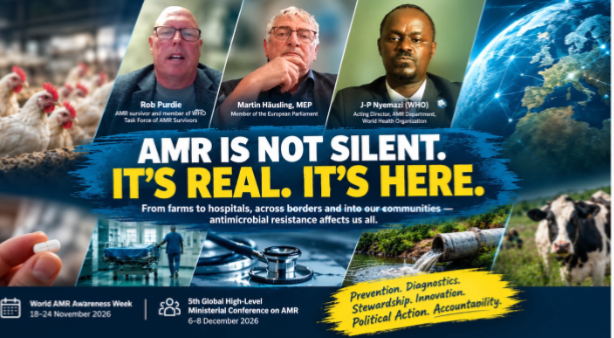
For Rob Purdie, antimicrobial resistance is not a scientific phrase or a distant global health threat. It is a permanent part of his life.
His story was among the human experiences presented at the European Parliament this week as the World Health Organisation (WHO) and lawmakers renewed calls for urgent action against antimicrobial resistance (AMR).
AMR occurs when bacteria, viruses, fungi or parasites stop responding to medicines designed to treat them.
The result can be devastating: infections that were once easily treated can become difficult, expensive or impossible to cure.
At least one million people die each year from bacterial AMR, according to WHO.
And the consequences go beyond hospitals.
Drug resistance threatens food production, livestock, household incomes, economies and the environment.
A warning for Africa
For countries across Africa, where access to quality healthcare and diagnostic services remains uneven, the AMR challenge is particularly urgent.
WHO’s Acting Director of the AMR Department, Dr Jean-Pierre Nyemazi, said people in some low- and middle-income countries struggle even to obtain a prescription.
Some therefore go directly to pharmacies or use medicines without appropriate diagnosis or medical supervision.
The answer, he said, cannot be reduced to telling people not to misuse antibiotics.
Countries also need stronger primary healthcare, accessible diagnostics, surveillance and enforcement against inappropriate over-the-counter sales of critically important medicines.
“Preventing infections is number one priority,” Nyemazi said, pointing to vaccination, infection prevention and control, water, sanitation and hygiene, better animal husbandry and responsible use of antimicrobials.
Purdie’s costly lesson
Purdie’s experience shows why diagnosis matters.
In 2012, what began as a severe headache was initially treated as a sinus infection.
Two courses of antibiotics failed. His condition deteriorated until doctors eventually diagnosed a fungal infection that had progressed to meningitis.
Several antifungal medicines subsequently failed.
Doctors eventually resorted to salvage treatment, including amphotericin B, an older medicine with serious side effects.
Purdie later developed skin cancer linked to one of the drugs and has remained on antifungal treatment for years.
He spent five years unable to work and support his family fully. His hospital bill alone reached about US$250,000.
For Purdie, the experience exposes the danger of delayed diagnosis and the limited arsenal available when medicines stop working.
“You lose a lot,” he said, urging the world to stop describing AMR as a “silent” pandemic.
The problem is bigger than antibiotics
German Member of the European Parliament Martin Häusling said the crisis also demands a rethink of how medicines are used in agriculture.
In some poultry production systems, he noted, antibiotics may be administered to entire flocks when only some birds are sick.
Wastewater from farms and slaughterhouses can also carry resistant organisms into the environment.
The concern extends to the use of critically important medicines in food-producing animals.
“We must reduce overall use, both in humans and in animals,” Häusling said.
That is the essence of One Health: human health cannot be separated from animal health, food systems and the environment.
From awareness to enforcement
WHO says Member States approved an updated Global Action Plan on AMR in May 2026, developed jointly with the Food and Agriculture Organisation, UN Environment Programme and World Organisation for Animal Health.
The plan puts prevention at the centre, from vaccination and infection control to WASH, responsible prescribing, surveillance and improved animal husbandry.
A global target adopted by UN Member States in 2024 seeks to reduce deaths from bacterial AMR by 10 per cent by 2030, compared with 2019 levels.
But Nyemazi stressed that commitments must translate into laws, funding and accountability.
That message matters in Africa, where the fight against AMR will depend not only on new medicines but on whether people can obtain the right diagnosis, access quality treatment and use medicines correctly.
The countdown to World AMR Awareness Week, 18-24 November, under the theme “One Health, One Action, Prevent AMR Now,” therefore comes with a simple challenge:
Protect the medicines that save us, before they stop working.
Join Our WhatsApp Community