African Feminists Urge AU To Pause Violence Treaty, Warn Flawed Convention Could Weaken Women’s Rights
By Shobha Shukla | CNS
Across Africa, one woman or girl experiences violence every few minutes, yet the very treaty intended to strengthen their protection is now facing growing criticism from women’s rights advocates who warn it could leave survivors with weaker legal safeguards instead of stronger ones.
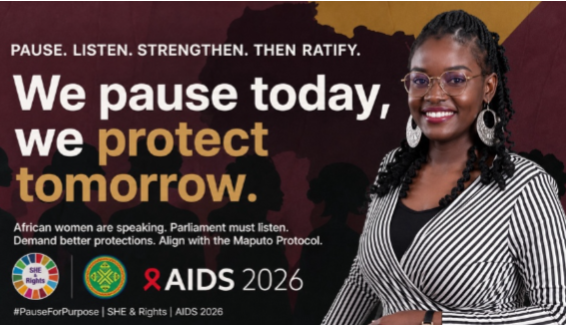
That concern has fuelled the #PauseForPurpose campaign, a coalition of African feminists, survivors, legal experts and civil society organisations urging the African Union (AU) to halt the ratification of the proposed African Union Convention on Ending Violence Against Women and Girls (AU CEVAWG) until key legal gaps are addressed.
The campaign insists it is not opposed to a continental treaty. Rather, it wants a stronger, legally enforceable convention capable of protecting women and girls for generations.
The issue featured prominently during a packed session at the 26th International AIDS Conference (AIDS 2026) in Rio de Janeiro, Brazil, where advocates linked shrinking gender rights and attacks on women’s freedoms to broader threats facing the global HIV response.
The discussion followed a protest staged on 25 July during a high-level meeting of the Pan-African Parliament, African Union Commission and partners, where leaders called for the swift signature and ratification of the convention.
While The Gambia became the first country to ratify the treaty, campaigners argued that speed should not come at the expense of strong legal protections.
“The protest was not to reject action against ending violence against women and girls,” said Mai Aman, Legal Officer at the Initiative for Strategic Litigation in Africa (ISLA). “It was to demand better action, better protections and a better convention.”
Speaking during the SHE & Rights session at AIDS 2026, Aman stressed that legally binding treaties shape national laws, court decisions and government accountability for decades.
“There is no contradiction between urgency and due diligence,” she said, arguing that the convention should strengthen, not dilute, the protections already guaranteed under the Maputo Protocol, Africa’s landmark women’s rights treaty.
Three major concerns
The #PauseForPurpose campaign identified three key areas requiring urgent attention.
Lack of meaningful consultation: Campaigners say many women’s organisations, survivors and civil society groups were excluded from drafting the treaty.
A survey of about 1,500 organisations found that only one-third knew the convention was being developed before its adoption, while 93 per cent said they had not been consulted.
“A treaty concerning African women cannot be developed without African women,” Aman said.
Weak legal protections: Rights groups argue that several protections are framed as aspirations rather than enforceable legal obligations.
They also say the draft inadequately addresses issues including female genital mutilation, child marriage, marital rape, trafficking and conflict-related sexual violence.
Campaigners are equally concerned about references to “family” and “African values”, warning that vague language could be exploited to justify discriminatory practices against women and girls.
Weak accountability mechanisms: Advocates say the draft fails to clearly spell out governments’ obligations, monitoring systems and remedies for survivors when states fail to comply.
They reject suggestions that legal shortcomings can be corrected after ratification through court action or future guidelines.
“Soft-law guidance cannot repair defects in a binding treaty,” Aman warned.
Four demands
The coalition is calling on the Pan-African Parliament and AU member states to:
Give equal hearing to women’s rights organisations, survivors and legal experts alongside supporters of immediate ratification.
Circulate the campaign’s memorandum to AU institutions and member states.
Pause further ratification pending an independent legal review.
Revise the treaty to align it with the Maputo Protocol and existing international human rights standards.
Campaigners argue that Africa needs more than a symbolic convention.
They want a legally robust treaty that clearly defines violence against women and girls, establishes enforceable state obligations and provides effective accountability for governments that fail to protect survivors.
With gender-based violence remaining one of Africa’s most persistent human rights challenges, often compounded by poverty, conflict and harmful cultural practices, the coalition believes a weak treaty risks undermining decades of progress.
“The demand is not to abandon continental action,” Aman said. “It is to ensure the convention reflects the realities of African women and girls and builds on the legal protections already secured.”
For the #PauseForPurpose movement, the message is clear: pause, listen, strengthen, then ratify.
Follow the Savinews Africa channel on WhatsApp: https://whatsapp.com/channel/0029VawgaEL5vKA9Y5XTFg0n
Join Our WhatsApp Community