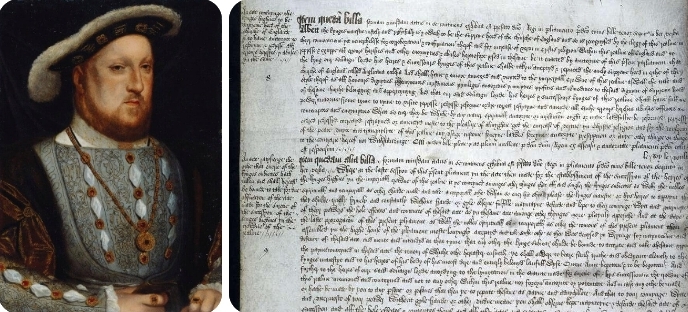
Henry VIII To Religious Repression: Revisiting the Bloody Origins Of The Anglican Break With Rome
The roots of the Church of England remain one of the most contested chapters in Christian history, marked by political power, religious upheaval, and, at times, brutal repression.
According to a post by a Roman Catholic priest, Rev. Fr Kelvin Ugwu, in 1534, England’s King, Henry VIII, formally broke away from the authority of the Catholic Church after Pope Clement VII refused to annul his marriage to Catherine of Aragon.
Through the historic Act of Supremacy 1534, Henry declared himself Supreme Head of the Church in England, effectively criminalising loyalty to Rome.
The consequences were immediate and severe. In 1535, prominent figures such as Thomas More and John Fisher were executed for refusing to swear allegiance to the Crown.
A year later, the Pilgrimage of Grace, a major Catholic-led rebellion against the dissolution of monasteries, was brutally suppressed, with many participants killed.
Following Henry’s death in 1547, his son Edward VI accelerated Protestant reforms.
However, a sharp reversal came in 1553 when Mary I of England restored Catholicism and re-established ties with Rome, overseeing the execution of over 280 Protestants, earning her the moniker “Bloody Mary.”
The pendulum swung again in 1558 under Elizabeth I, who reinstated the Church of England’s independence through the Act of Supremacy 1559.
Tensions escalated in 1570 when Pope Pius V excommunicated Elizabeth via Regnans in Excelsis, declaring her illegitimate.
Elizabeth’s government responded with harsh penalties against Catholics. Laws enacted in 1581 criminalised Catholic worship, banned priests from operating in England, and made harbouring clergy a capital offence.
Catholics faced exclusion from public life, property restrictions, and imprisonment, with many executed or dying in custody.
Religious restrictions persisted for centuries. It was not until the Catholic Relief Act 1791 that Catholics regained limited rights to worship, and full political participation only came with the Catholic Emancipation Act 1829.
Notably, many iconic English cathedrals, including Canterbury Cathedral, Westminster Abbey, St. Paul’s Cathedral, York Minster, and Durham Cathedral, originated as Catholic institutions before the English Reformation.
Today, the legacy of the split continues to shape religious and constitutional life in Britain, where the monarch is still required to be in communion with the Church of England.
Follow the Savinews Africa channel on WhatsApp: https://whatsapp.com/channel/0029VawgaEL5vKA9Y5XTFg0n