ECOWAS Parliament Seeks Urgent Fund To Rescue Trafficked Children
For millions of children across West Africa, childhood is being stolen by human trafficking, forced labour and exploitation.
Instead of sitting in classrooms, playing with friends or enjoying the protection of their families, many are trapped in dangerous working conditions, separated from loved ones and exposed to abuse.
Concerned by the scale of the crisis, the ECOWAS Parliament has called for the establishment of a regional victim support fund to provide assistance to rescued children and survivors of human trafficking, as part of renewed efforts to strengthen child protection across West Africa.
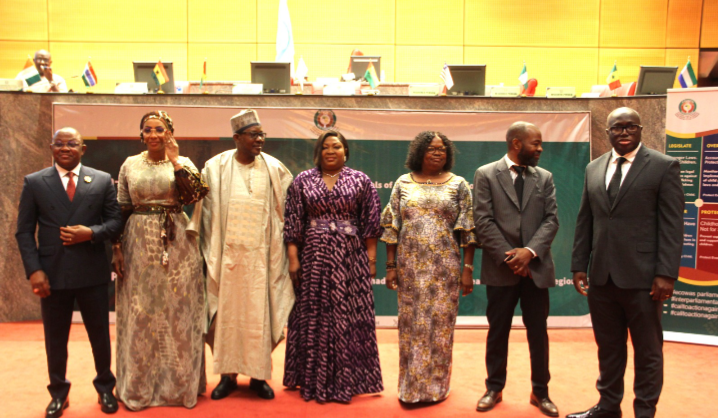
The call was made by the Speaker of the ECOWAS Parliament at a regional parliamentary workshop on combating child trafficking and child labour during the ongoing Second Ordinary Session of the Parliament in Abuja.
The Speaker expressed concern that despite existing laws and international commitments, millions of vulnerable children across the region remained exposed to trafficking and exploitative labour, largely due to weak enforcement, inadequate funding and poor institutional coordination.
She said children subjected to trafficking and forced labour were not only denied their fundamental human rights but also deprived of education, personal development and the opportunity to contribute meaningfully to society.
She challenged parliamentarians to move beyond declarations and commitments by holding governments accountable for the implementation of child protection policies.
According to her, lawmakers must scrutinise budgetary allocations, monitor enforcement of existing laws and ensure that government interventions deliver measurable improvements in the lives of vulnerable children.
She urged participants to develop practical recommendations, assign clear responsibilities and establish monitoring mechanisms to strengthen regional parliamentary cooperation.
Representing the Secretary-General of the Inter-Parliamentary Union (IPU), Senior Programme Officer, Akiyo Afouda, said the scale of child exploitation required urgent and coordinated action, disclosing that an estimated 138 million children worldwide were still engaged in child labour, including 46.6 million in sub-Saharan Africa.
He described the figures as disturbing, noting that poverty, insecurity, population displacement, economic inequalities and weak social protection systems continued to expose children to trafficking and forced labour.
Afouda stressed that the cross-border nature of human trafficking made it difficult for individual countries to tackle the menace without stronger regional cooperation.
He identified sustained political commitment, structured cooperation among national parliaments, effective parliamentary oversight and credible monitoring and evaluation mechanisms as essential pillars of a regional response.
He also urged lawmakers to ensure that child protection commitments were backed by adequate funding and effective legislation.
“The success of parliamentary action should be measured by the number of children rescued, protected and returned to school, rather than the number of resolutions adopted,” he stressed.
Providing further insight into the regional situation, the ECOWAS Commissioner for Human Development and Social Affairs, Professor Nassirou Arifari Bako, identified insecurity, displacement and inadequate social protection as major factors exposing children to trafficking and exploitative labour.
He explained that conflicts and instability in parts of the Sahel had disrupted education, separated families and heightened the vulnerability of women and children to exploitation, particularly among displaced populations moving across borders.
Bako, however, disclosed that ECOWAS had recorded an increase in prosecutions and convictions for trafficking-related offences, from 388 cases in 2024 to 515 in 2025 across the region.
Despite the progress, he maintained that existing interventions remained insufficient in the face of the growing challenge.
He expressed concern over the limited coverage of social protection programmes in West Africa and called for increased investment to protect vulnerable households and prevent children from falling victim to trafficking and exploitative labour.
The Commissioner also threw his weight behind the proposed regional victim support fund, urging member states to establish dedicated victim trust funds to assist rescued children and other trafficking survivors.
He called on parliamentarians to advocate increased government spending on social protection, strengthen data collection and sharing through interconnected national social registries, and conduct oversight visits to assess the implementation of child protection policies.
According to him, these measures would improve victim identification, rehabilitation and reintegration, while expanding access to education and vocational training.
Bako emphasised that the ECOWAS Commission could not address the crisis alone, stressing that national and regional parliaments must deploy their legislative and oversight powers to turn existing policies into tangible results.
The workshop also reviewed progress made since an earlier engagement between the IPU and the ECOWAS Parliament in May 2023, which produced recommendations for strengthening national initiatives and regional parliamentary coordination.
Afouda called for regular parliamentary monitoring, joint missions to vulnerable communities and stronger engagement with local populations to identify trafficking networks and protect children at risk.
He urged lawmakers to maintain close contact with their constituencies, noting that community-level engagement remained critical to understanding the realities of child trafficking and exploitation.
Participants were encouraged to develop a coordinated regional framework that would strengthen prevention, prosecution, victim identification, rehabilitation and reintegration.
The central message from the engagement was clear: rescuing trafficked children is only the first step.
Without sustained funding, access to education, rehabilitation and effective reintegration, many survivors risk returning to the same conditions that exposed them to exploitation in the first place.
Join Our WhatsApp Community