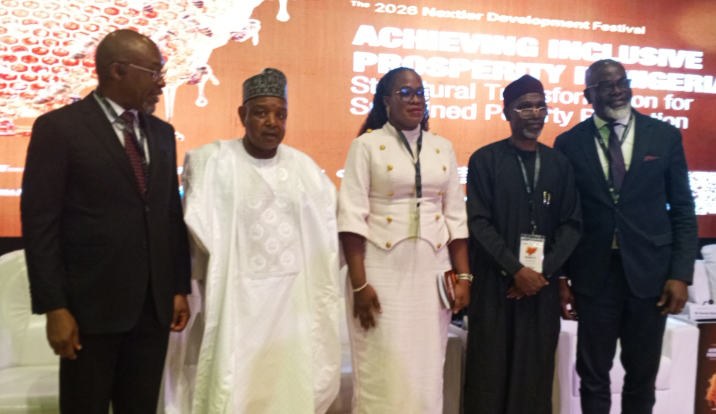
Nigeria Must Invest In Local Communities To Drive Prosperity – Bagudu
Princess-Ekwi Ajide
A fishing community using outdated methods or a rural woman struggling with poor-quality seeds could hold the key to Nigeria’s economic prosperity if governments invest in local opportunities, the Minister of Budget and Economic Planning, Abubakar Bagudu, has said.
Bagudu called for a shift from top-down development planning to a community-driven approach that identifies the economic potential of local areas and directs public investment towards addressing poverty and creating wealth.
Speaking during a panel discussion moderated by Patrick Okigbo Jnr, Bagudu said Nigeria had completed the economic mapping of its 8,809 wards to identify their economic drivers, poverty challenges and opportunities for growth.
He argued that understanding the needs of individual communities would help governments make better investment decisions and ensure development plans translate into tangible improvements in people’s lives.
The minister also highlighted Nigeria’s limited public resources, noting that the country’s budget had remained small compared with those of countries with similar population sizes.
He said Nigeria needed to rethink revenue generation and attract more capital to address years of underinvestment in public services and infrastructure.
Bagudu linked the ambition of building a $1 trillion economy by 2030 to the need for policies that sustain investor confidence and spread economic opportunities across the country.
Other panellists, including former Minister of Aviation Osita Chidoka and Anambra State Secretary to the State Government, Chiamaka Nnake, examined the institutional and administrative challenges that often prevent development plans from producing results.
Nnake identified execution as a major weakness in Nigeria’s development process, arguing that ambitious plans frequently falter because of inadequate resources, weak institutions and poor coordination.
She said public institutions needed stronger systems to ensure continuity beyond individual political tenures, while warning that short-term political priorities often undermine long-term development goals.
Chidoka, drawing on his experience in public service, stressed the need to rebuild the civil service and preserve institutional knowledge so that reforms and initiatives do not disappear when political officeholders leave.
He advocated stronger administrative systems, better record-keeping and digital processes to improve accountability and ensure government policies survive changes in leadership.
Another panellist, Esanbo Inga, emphasised the importance of linking long-term development plans to medium-term sector strategies and annual budgets, arguing that the absence of this connection weakens accountability for results.
The discussion also highlighted the need for greater coordination among ministries, departments and agencies, particularly when businesses require multiple government approvals to establish or expand operations.
The panellists agreed that Nigeria’s development challenge goes beyond producing policy documents.
It requires adequate funding, effective institutions, sustained implementation and a clearer connection between government spending and measurable outcomes for citizens.
Join Our WhatsApp Community