Community Support Helps Migrant Worker Beat Deadly Drug-Resistant TB
By Shobha Shukla
For 55-year-old Mahesh, recovering from tuberculosis (TB) was about more than taking medicines.
It meant choosing between earning a daily wage and staying alive, battling a fractured leg and finding the strength to continue treatment despite repeated setbacks.
A migrant daily-wage worker living in a crowded slum in central Delhi, India, Mahesh was diagnosed with multidrug-resistant tuberculosis (MDR-TB), one of the most difficult forms of TB to treat.
At different points, poverty, the demands of earning a living and a road accident threatened to derail his recovery.
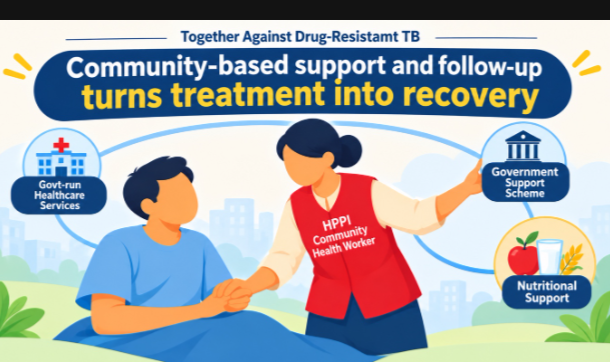
But the intervention of community health workers, supportive doctors and government assistance programmes helped him overcome these barriers and complete his treatment journey.
His experience offers a powerful lesson in the fight against drug-resistant TB: medicines alone are not enough; patients also need people and systems that support them through recovery.
A diagnosis that changed everything
Mahesh lives with his wife, 22-year-old son and other family members in a small, overcrowded home in central Delhi.
His family depends largely on his daily earnings, making any period of illness a financial burden.
In early 2025, he developed persistent high fever, severe body aches and extreme weakness.
He initially sought treatment from private practitioners, but the medicines prescribed brought little relief.
As his condition deteriorated, a doctor advised him to visit the government-run Jhandewalan Chest Clinic for further investigations.
An X-ray and sputum examination were conducted at the clinic, while an ultrasound was performed at Dr NC Joshi Memorial Hospital, another government health facility.
The results confirmed multidrug-resistant TB (MDR-TB), a serious form of tuberculosis in which the bacteria are resistant to at least two powerful first-line medicines: isoniazid and rifampicin.
Mahesh said he was the first member of his family to contract TB. He began treatment in April 2025.
However, getting diagnosed and starting medication were only the first hurdles.
When earning a living threatens recovery
As his health improved, Mahesh resumed travelling outside Delhi in search of work. Like many daily-wage earners, he could not afford to remain at home for long without losing the income his family depended on.
The pressure to earn eventually disrupted his treatment. He stopped taking his medication.
Interrupting MDR-TB treatment can have serious consequences, including treatment failure, prolonged illness, continued transmission and the development of further drug resistance.
Mahesh’s experience highlights a difficult reality for vulnerable patients: the struggle to survive financially can undermine the struggle to recover medically.
His treatment journey might have ended there if community health workers had not intervened.
A community worker brings him back
In October 2025, during routine door-to-door TB screening in his neighbourhood, Shimpi and Geeta, frontline field officers with Humana People to People India (HPPI), came across Mahesh.
Geeta is herself a TB survivor, giving her personal insight into the difficulties patients face during treatment.
Recognising the danger of Mahesh’s treatment interruption, Shimpi began counselling him repeatedly.
She explained why completing his prescribed medication was essential, not only for his recovery but also to protect his family and the wider community.
Her intervention went beyond providing information.
She built trust, listened to his concerns and encouraged him to reconnect with the public healthcare system.
With continued encouragement and emotional support, Mahesh agreed to resume treatment.
Shimpi accompanied him to the Jhandewalan Chest Clinic, liaised with the doctors and requested that his medication be restarted.
He resumed treatment, taking seven tablets every morning after breakfast.
Although he experienced hot flushes after taking the medicines, he managed to undertake some light work to support his family.
Then another setback threatened his progress.
A broken leg, but treatment continues
Mahesh was involved in an accident that left his legs fractured.
Doctors advised complete bed rest, making it impossible for him to visit the chest clinic to collect his medicines.
Given his previous treatment interruption, the development raised concerns about another break in therapy.
But this time, the support system around him responded quickly.
Shimpi informed the doctors at the chest clinic about his condition and requested special arrangements to ensure that he continued receiving his medication while recovering at home.
She also assured the health authorities that she would remain involved in monitoring his treatment.
The doctors agreed.
They allowed Shimpi to collect Mahesh’s medicines from the clinic and deliver them directly to his home until he regained the ability to walk.
The arrangement helped prevent another interruption in treatment.
Mahesh has since recovered sufficiently to visit the clinic and collect his medicines himself.
His experience demonstrates how cooperation between community organisations and public healthcare facilities can remove practical barriers that might otherwise put vulnerable patients at risk.
Financial and nutritional support ease the burden
Beyond treatment follow-up, Mahesh also received assistance to address the economic and nutritional challenges associated with TB.
With the support of Shimpi and Geeta, he received nutritional assistance twice under India’s Pradhan Mantri TB Mukt Bharat Abhiyaan.
He also received 1,000 Indian rupees monthly, transferred directly into his bank account under the Ni-Kshay Poshan Yojana, during the months he remained on treatment. Payments stopped during the period when he discontinued his medication.
For a daily-wage worker whose ability to earn is affected by illness, such assistance can help ease the burden of accessing adequate nutrition and meeting basic needs.
The support also illustrates why TB programmes must look beyond diagnosis and medication.
Patients facing poverty, food insecurity and unstable employment need social protection to give them a realistic chance of completing treatment.
‘I could not have adhered to treatment without her’
Reflecting on the support he received, Mahesh expressed gratitude to Shimpi.
“I could not have adhered to MDR-TB treatment without the help of didi,” he said.
Didi, a Hindi word meaning sister, is the affectionate name he uses for the community health worker.
For Shimpi, helping vulnerable people access healthcare is more than a job.
“It gives me genuine satisfaction to help people who are surrounded by problems so much so that they are not able to reach even a nearby chest clinic on their own.
Trying to help them access health services gives me tremendous energy and hope to keep striving on. I do not work here just to earn a living but also to render services to other needy human beings,” she said.
Her commitment reflects the often-overlooked contribution of frontline community health workers who connect underserved populations with essential public health services.
Their work is strengthened when healthcare professionals, government agencies, community organisations and social protection programmes work together.
The bigger lesson in the fight against TB
Tuberculosis is preventable and curable, yet it remains one of the world’s deadliest infectious diseases. Its impact is particularly severe among people living in poverty, overcrowded settlements and communities with limited access to healthcare.
For vulnerable populations, the obstacles are rarely isolated. Migration, insecure employment, stigma, poor nutrition, financial hardship and physical disabilities can combine to delay diagnosis and interrupt treatment.
Mahesh’s journey shows why tackling drug-resistant TB requires more than making medicines available.
Community-based screening can identify patients who might otherwise remain outside the healthcare system. Counselling and regular follow-up can help prevent treatment interruptions, while flexible arrangements for medicine collection can ensure that physical barriers do not become obstacles to recovery.
Equally important is connecting patients to nutritional and financial assistance so that the cost of staying alive does not become another burden.
As India pursues its TB elimination ambitions, strengthening these community-to-healthcare connections will be essential.
Mahesh’s experience is a reminder that successful treatment often depends on an entire network of people: a community worker who refuses to give up, a fellow survivor who understands the struggle, doctors who respond to patients’ circumstances and government programmes that help address the financial pressures of illness.
The fight against drug-resistant TB cannot be won with medicines alone. It also requires compassion, community action and a healthcare system that stays with patients until they recover.
Shobha Shukla is a feminist, health and development justice advocate, award-winning founding Managing Editor and Executive Director of CNS (Citizen News Service).
She is also Chairperson of the Global AMR Media Alliance (GAMA).
Shared under a Creative Commons licence.
Join Our WhatsApp Community